About RASONQUE

true
spacing-45
mobile-spacing-35
styled-text

RASONQUE was studied in a clinical trial called RASolute 302

margin-bottom-xxl
mobile-margin-bottom-40
text-color-denim-blue
styled-text
The trial included 500 adults:
margin-bottom-md
mobile-margin-bottom-15
text-color-denim-blue
styled-text
  • With pancreatic cancer that had spread to other parts of the body (metastatic)
  • ​Whose cancer progressed after prior chemotherapy
  • ​Whose cancer did or did not have a RAS mutation*

margin-bottom-lg
mobile-margin-bottom-35
text-color-denim-blue
People received either:
2 tablets icon
RASONQUE, orally,
once daily
(248 people)
IV bag icon
Chemotherapy, by infusion
(252 people)
or

*The trial included 459 people whose cancer had a RAS G12 mutation and 41 people whose cancer did not have a RAS G12 mutation.

The chemotherapy that people received was chosen by their doctor from the following combinations: modified FOLFIRINOX (leucovorin + fluorouracil + irinotecan + oxaliplatin); gemcitabine + nab-paclitaxel; FOLFOX (leucovorin + fluorouracil + oxaliplatin); or liposomal irinotecan + fluorouracil/leucovorin.

styled-text

The trial compared RASONQUE to chemotherapy

margin-top-lg
margin-bottom-md
mobile-margin-top-25
mobile-margin-bottom-20
text-color-denim-blue
styled-text
The main goals of the trial were to study:
margin-top-none
margin-bottom-sm
mobile-margin-top-none
mobile-margin-bottom-10
text-color-denim-blue
styled-text
  • ​Overall survival: How long people lived after starting treatment
  • Progression-free survival: How long people lived without their cancer growing or spreading after starting treatment
margin-bottom-lg
mobile-margin-bottom-25
text-color-90-black
styled-text
The trial also studied:
margin-top-none
margin-bottom-sm
mobile-margin-top-none
text-color-denim-blue
styled-text
  • Tumor response: How many people had their tumors shrink
  • Duration of response: How long a person's cancer responded to treatment
  • Safety: What side effects people had after starting treatment
  • Health-related quality of life: How long people lived without their health-related quality of life getting worse
text-color-90-black
spacing-45
mobile-spacing-35
spacing-45
mobile-spacing-35
styled-text

What results did people have with RASONQUE?

margin-bottom-md
mobile-margin-bottom-25
text-color-denim-blue
spacing-xs
styled-text
RASONQUE was studied in people whose metastatic pancreatic cancer had a RAS G12 mutation and those whose cancer did not have a RAS G12 mutation. Researchers looked at the trial data from people whose cancer had a RAS G12 mutation first. Then, they looked at the data from everyone in the trial.
margin-bottom-sm
text-color-90-black
styled-text
Of people whose cancer had a RAS G12 mutation:
margin-bottom-sm
text-color-denim-blue
styled-text
  • ​The median overall survival for people who received RASONQUE was 13.2 months compared to 6.6 months for those who received chemotherapy
  • The median progression-free survival for people who received RASONQUE was 7.3 months compared to 3.5 months for those who received chemotherapy
margin-bottom-lg
text-color-90-black
styled-text

Of everyone in the trial:

text-color-denim-blue
styled-text

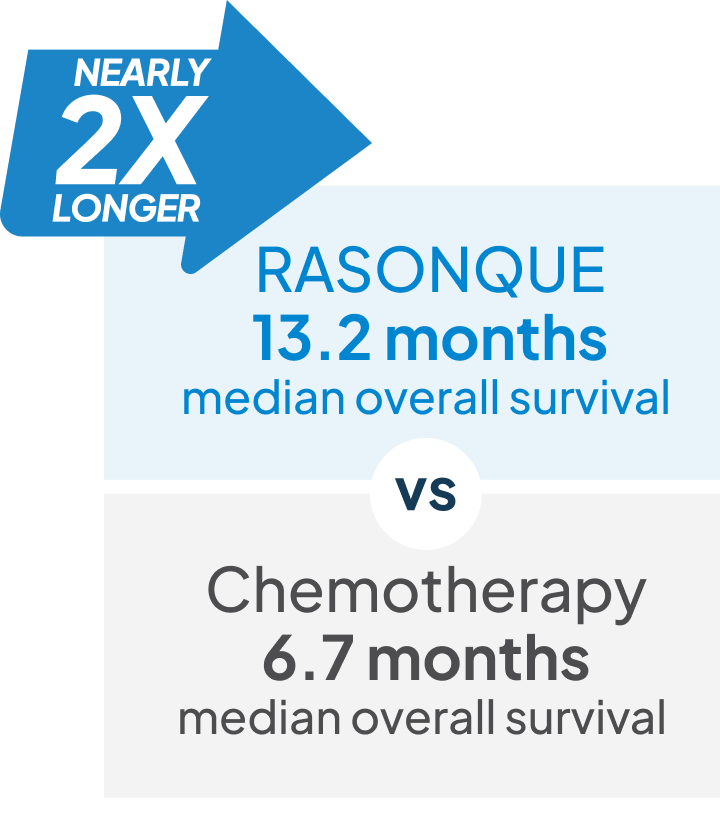
RASONQUE  helped people live longer compared to chemotherapy

margin-bottom-md
mobile-margin-bottom-5
text-color-denim-blue
Graphic depicting overall survival for everyone in the trial. A blue arrow that says 2x longer points to the RASONQUE endpoint, 13 months median overall survival. A VS symbol separates that from the chemotherapy endpoint, 6.7 months median overall survival.
styled-text
  • ​People who received RASONQUE had a 60% reduction in their risk of death compared to those who received chemotherapy
margin-top-xl
margin-bottom-xl
mobile-margin-top-25
mobile-margin-bottom-10
text-color-90-black
styled-text
Median overall survival is the length of time when half the people on treatment are still living.
margin-bottom-xl
mobile-margin-bottom-30
text-color-90-black
spacing-md
styled-text

Of everyone in the trial:

text-color-denim-blue
styled-text

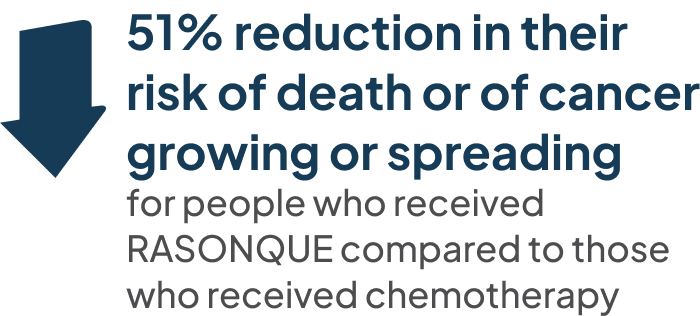
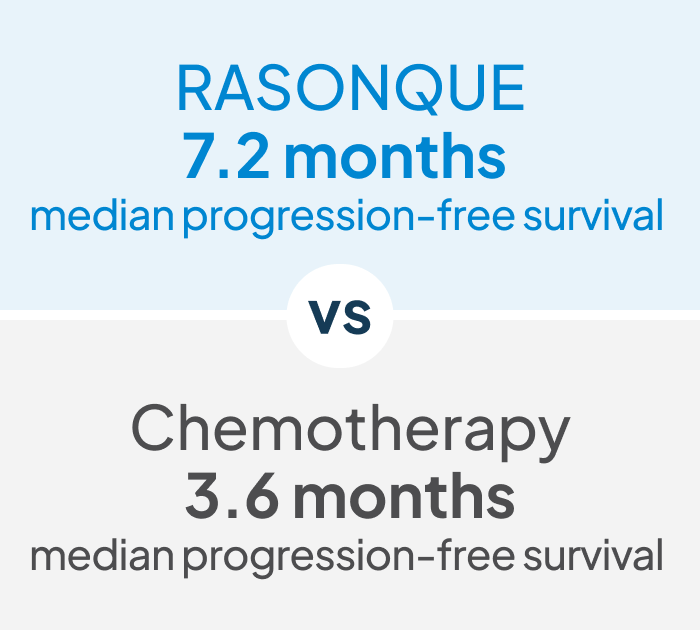
RASONQUE doubled the time people lived without cancer growing or spreading compared to chemotherapy

margin-bottom-lg
mobile-margin-bottom-10
text-color-denim-blue
Graphic depicting progression-free survival for everyone in the trial. A blue arrow that says 2x longer points to the RASONQUE endpoint, 7.2 months median progression-free survival. A VS symbol separates that from the chemotherapy endpoint, 3.6 months median progression free survival.
spacing-30
An arrow points down next to text that says 51% reduction in their risk of death or of cancer growing or spreading for people who received RASONQUE compared to those who received chemotherapy
spacing-30
styled-text
Median progression-free survival is the length of time when half the people in the trial are still living without their cancer growing or spreading.
margin-top-lg
margin-bottom-none
mobile-margin-top-20
text-color-90-black
styled-text

Additional results

margin-bottom-sm
text-color-denim-blue
styled-text

Tumor response

text-color-denim-blue
graphic
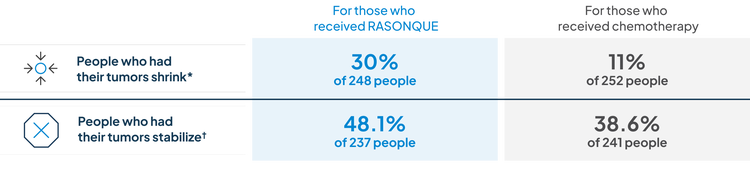
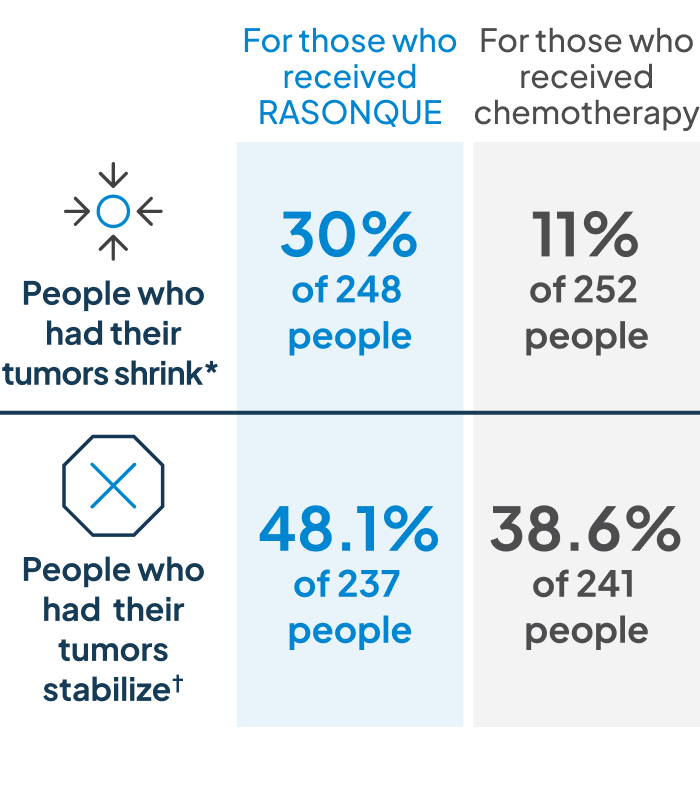
Disease control rate chart: RASONQUE vs chemotherapy. Tumor shrinkage: 31.6% of people (75 of 237) who received RASONQUE had their tumors shrink vs 11.2% of people (27 of 241) who received chemotherapy. Tumor stabilization: 48.1% of people (114 of 237) who received RASONQUE had their tumors stabilize vs 38.6% of people (93 of 241) who received chemotherapy.
spacing-lg
spacing-30
spacing-30
styled-text
Stabilize (stable disease) means that changes in tumor sizes were too small to be reported as growing or shrinking. This may be due to how tumors behave naturally rather than any effect of the medicine. Please consider that these results are not definitive, and individual results may vary.
margin-top-none
margin-bottom-sm
text-color-90-black
styled-text
These results were not tested for statistical significance and not designed to show differences between treatments. Statistical significance is a mathematical measure that shows whether a difference between groups is greater than what might be expected (predicted) to happen by chance alone.
margin-top-none
margin-bottom-sm
mobile-margin-bottom-30
text-color-90-black
styled-text

*Evaluated in everyone in the trial.

Evaluated in people who had measurable disease before starting treatment in the trial.

margin-top-none
margin-bottom-md
text-color-black
styled-text

Additional results

margin-bottom-sm
text-color-denim-blue
styled-text
margin-bottom-md
text-color-denim-blue
styled-text
Health-related quality of life is how a person feels about their overall physical and mental health over a period of time.
margin-bottom-sm
text-color-90-black
styled-text
How was health-related quality of life studied?
margin-bottom-sm
text-color-denim-blue
styled-text
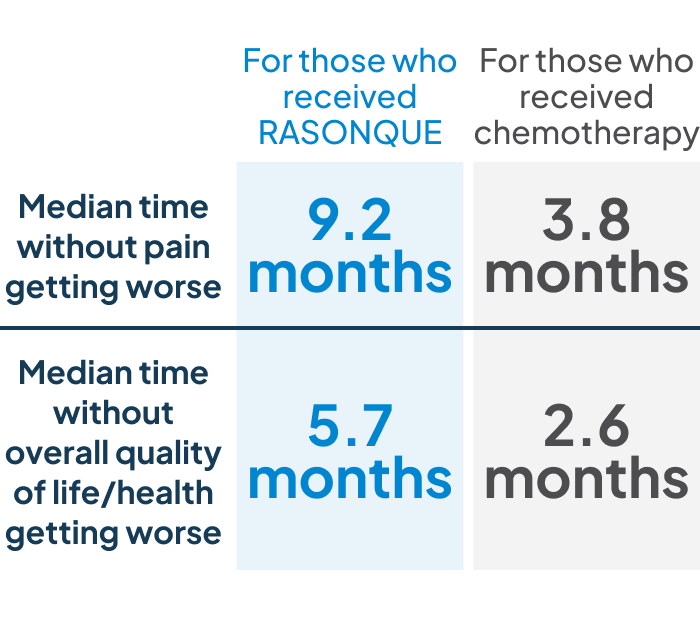
People in the trial completed questionnaires about their health-related quality of life each month. They answered each question with a numeric score. This helped researchers find out how much time people had before certain measures got worse. These measures included overall quality of life/health and pain.
margin-bottom-sm
text-color-90-black
styled-text
  • ​Consider these results carefully. The results shown here may be unrelated to treatment. In addition, the trial was an open-label study. This means that both the researchers and the participants knew which treatment they were receiving

text-color-90-black
spacing-15
mobile-spacing-20
graphic
Health-related quality of life chart: RASONQUE vs chemotherapy. Median time without pain getting worse: People who received RASONQUE had 9.2 months without pain getting worse vs 3.8 months for those who received chemotherapy. Median time without overall quality of life or health getting worse: People who received RASONQUE had 5.7 months without their overall quality of life or health getting worse vs 2.6 months for those who received chemotherapy.
styled-text
The surveys used were the European Organization for Research and Treatment of Cancer Quality of Life Questionnaire (EORTC QLQ-C30) and EORTC QLQ-PAN26.
margin-top-sm
margin-bottom-sm
mobile-margin-top-30
mobile-margin-bottom-20
text-color-90-black
styled-text
Median is the middle number in a set of numbers.
margin-top-none
margin-bottom-xl
text-color-90-black
spacing-50
mobile-spacing-35
See how once-daily treatment with RASONQUE may fit into your routine
Explore the dosing schedule
true
spacing-45
mobile-spacing-35
spacing-45
mobile-spacing-35
styled-text

Side effects

font-size-xxl
mobile-font-size-xxxl
text-color-denim-blue
spacing-30
mobile-spacing-25
styled-text
Serious common side effects were:
margin-bottom-sm
text-color-denim-blue
Rash icon
Rash
Diarrhea icon
Diarrhea
Mouth sores icon
Swelling or sores in the mouth
styled-text
Additional common side effects were:
margin-top-lg
mobile-margin-top-20
text-color-denim-blue
styled-text
  • Nausea
  • Tiredness or weakness
  • Vomiting
  • Stomach (abdominal) pain
  • Swelling in the arms and legs
  • Decreased appetite
  • Bleeding
margin-top-md
margin-bottom-lg
mobile-margin-bottom-20
text-color-90-black
styled-text
RASONQUE can cause serious side effects, including: skin reactions, swelling or sores in the mouth (stomatitis), diarrhea, tears in your stomach or intestines (gastrointestinal perforation), and lung or breathing problems (pneumonitis). RASONQUE can harm your unborn baby.
margin-bottom-sm
mobile-margin-bottom-20
text-color-90-black
styled-text
These are not all the possible side effects of RASONQUE. Call your doctor for medical advice about side effects.
margin-bottom-none
mobile-margin-bottom-none
text-color-90-black
spacing-45
mobile-spacing-35
spacing-45
mobile-spacing-35
styled-text

What should I do if I have side effects?

mobile-font-size-xxxl
margin-bottom-lg
text-color-denim-blue
styled-text

Call your care team right away

margin-bottom-lg
text-color-denim-blue
secondary

Everyone on your care team has the same goal: to help you manage side effects and continue treatment.

Your care team may include:

  • ​Oncologists
  • Physician assistants
  • Nurses and nurse practitioners
  • ​Nurse navigators
  • Pharmacists
  • Dietitian/nutritionist

You and your caregiver are the leaders of your team! Make sure to use your voice and connect with your care team when you need to.

Care team icon
styled-text
Your doctor may adjust your dose if you have side effects with RASONQUE
margin-top-lg
mobile-margin-top-20
text-color-denim-blue
styled-text
  • ​97.1% of people who received RASONQUE did not have to stop treatment because of side effects

  • People who received RASONQUE may have had their dose paused or adjusted to help manage side effects

    • 69% of people had their dose paused
    • 37% of people had their dose reduced
margin-top-md
margin-bottom-lg
mobile-margin-bottom-20
text-color-90-black
without-image
Your care team will recommend certain medicines and products that may reduce side effects
spacing-10
spacing-50
styled-text

Managing side effects

margin-bottom-lg
mobile-margin-bottom-25
text-color-denim-blue
styled-text

Review what some common side effects from treatment with RASONQUE may look like

margin-bottom-lg
mobile-margin-bottom-25
text-color-denim-blue
styled-text
Rash is the most common side effect of RASONQUE
margin-bottom-md
text-color-denim-blue
styled-text
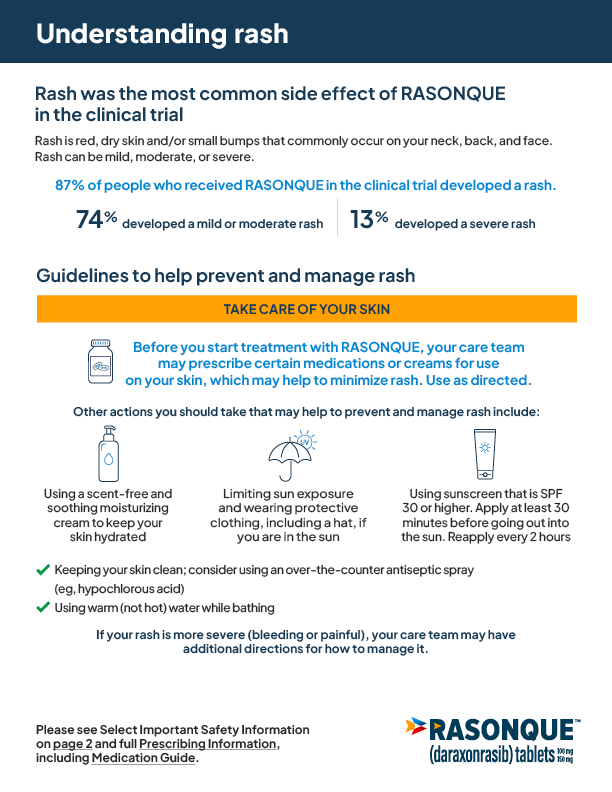
  • ​87% of people who received RASONQUE had a rash
  • Your care team will recommend certain medicines or products to start before taking RASONQUE to help reduce the risk
of rash
margin-bottom-xl
mobile-margin-bottom-25
text-color-90-black
side-effect-safety-secondary
Guidelines to help prevent and manage rash
Rash icon
styled-text
To help prevent and manage rash, you SHOULD:
margin-top-sm
margin-bottom-sm
text-color-denim-blue
styled-text
  • Apply certain medications to your skin (face and body) before your first dose;
talk to your care team

  • Use a scent-free and soothing moisturizer to keep your skin hydrated

  • Limit sun exposure and wear protective clothing, including a hat, if you are in the sun

  • Use sunscreen that is SPF 30 or higher

    • Apply at least 30 minutes before going out into the sun. Reapply every 2 hours
  • Discuss taking oral antibiotics with your care team

    • Your doctor may recommend you start taking these before your treatment with RASONQUE starts
    • If you have questions or concerns about taking antibiotics, talk with your care team
  • Keep your skin clean; consider using an over-the-counter antiseptic spray (eg, hypochlorous acid)

  • Use warm (not hot) water while bathing
margin-bottom-sm
text-color-90-black
styled-text
Always talk to your care team about how you’re feeling. They can help you better understand any side effects you have. They may be able to help you manage them so you can feel better.
margin-bottom-sm
text-color-90-black
styled-text
Your care team can help you manage rash
margin-bottom-sm
text-color-denim-blue
styled-text
Rash can be mild, moderate, or severe. If you develop a rash, take a photo of it to share with your care team. This way, they can help you monitor it and decide what action, if any, is needed.
margin-bottom-sm
text-color-90-black
styled-text
If your rash is more severe (bleeding or painful), your care team may have additional directions for how to manage it.
margin-bottom-lg
mobile-margin-bottom-25
text-color-90-black
graphic
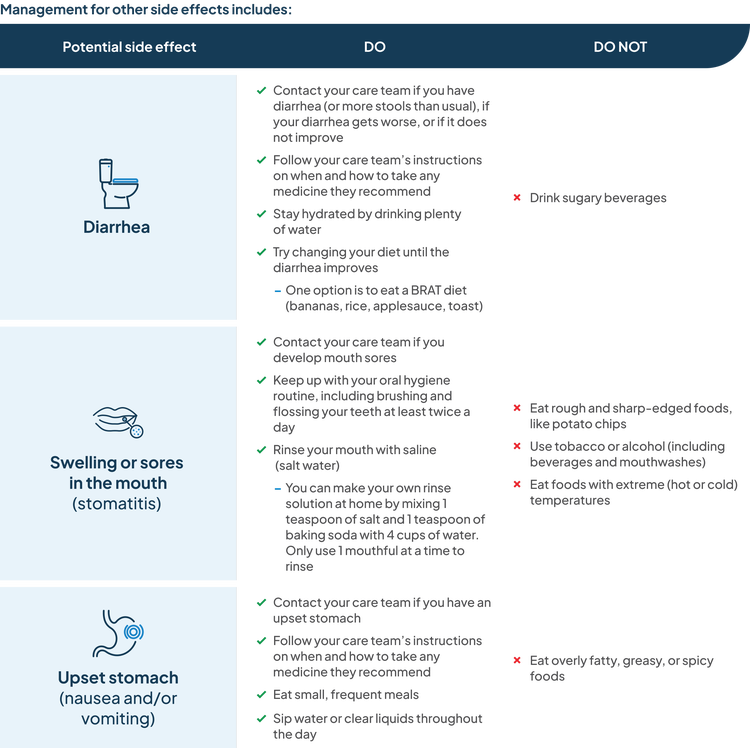
Icons and a list of steps to help manage diarrhea, mouth sores, and upset stomach
styled-text
Track any side effects you have. This information can help your care team decide how to move forward.
margin-top-xxl
margin-bottom-xxl
text-color-denim-blue
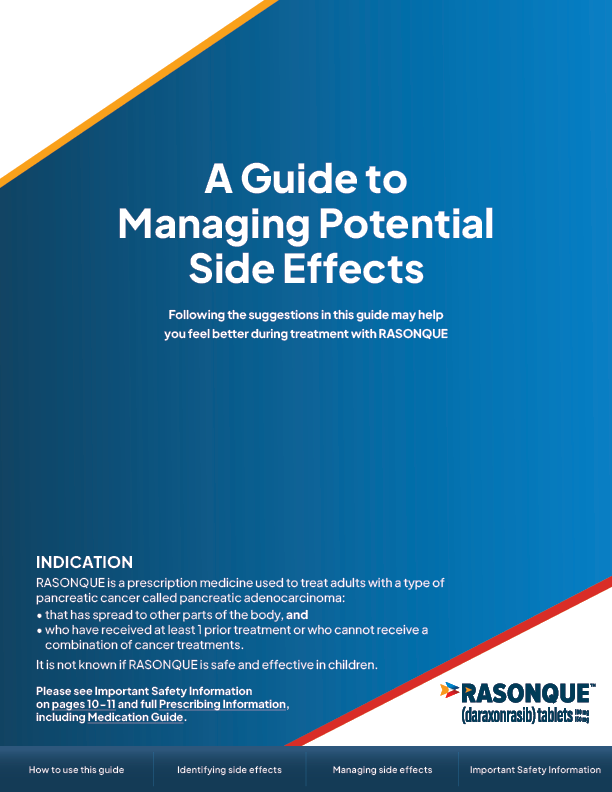
Side Effects Management Guide cover
Side Effects Management Guide
Download this guide to learn more about side effects that can occur with RASONQUE and find ways to help manage them.
Download
Rash Management Card cover
Rash Management Card
Supplies details on rash as a potential side effect and how to manage it.
Download
spacing-45
mobile-spacing-35
spacing-10
spacing-10
spacing-50
mobile-spacing-50